(!)Due to
Microsoft's end of support for Internet Explorer 11 on 15/06/2022, this site does not support the recommended
environment.
Instead, please kindly use other browsers like Google Chrome, Microsoft Edge or Mozilla
Firefox.
- Website Upgrade Completed! System improvements are now LIVE to improve your Ordering experience. You may be logged out after the website update, please log in again.
Spring
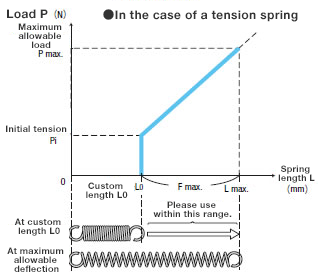
Tension spring
Load P [N] = initial tension Pi [N] + (spring constant k [N/mm] × deflection F [mm])
- MISUMI's tension springs (excluding configurable types) are standardized such that the maximum load is constant for a given diameter. Since the maximum load value is used as the standard for manufacturing, the initial tension and spring constant values are reference values.
- Please use at allowable deflection F max. (mm) or less. Use in excess of the allowable deflection may cause the spring to deform or break after a small number of uses. Be careful not to stretch tension springs beyond the allowable deflection during installation as well.
- Tension springs (AW□, BW□, AWFM, WFSP, LWS, LWSH) are recommended to be used at room temperature (40°C or lower). Use at above 40°C may cause load values to decay depending on conditions.
Round wire compression springs and irregular cross section wire springs
Load P [N] = (spring constant k [N/mm] × deflection F [mm])
-
MISUMI's round wire compression springs are standardized such that the spring constant is
constant for a given diameter. Spring constant tolerance is ±10%.
Irregular cross section wire springs are standardized such that the maximum load is constant for a given diameter. Tolerances for load values vary for each type, so please refer to the page for each type. -
Please use at allowable deflection F max. (mm) or less. If used in excess of the allowable
deflection, the spring may deform or break.
Solid lengths are reference value. Deflection to the solid length may cause deformation or breakage of the spring after a small number of uses. -
The coil diameter of round wire compression springs are manufactured with priority given to
outer diameter tolerances for the outer diameter standard type and inner diameter tolerances
for the inner diameter standard type, respectively.
For inner/outer diameter tolerances of irregular cross section wire springs, please refer to the page for each type. - Round wire compression springs (W□, NW□, FW□, U□, FU□) and irregular cross section wire springs (SWF, SWL, SWM, SWH, SWB) are recommended to be used at room temperature (below 40°C). Use at above 40°C may cause load values to decay depending on conditions. (Heat-resistant springs are listed in Standard Parts for Plastic Molds.)
- Irregular cross section wire springs are also listed in Standard Parts for Press Dies and Standard Parts for Plastic Molds. (Large diameter sizes are also listed.)
Relationship between spring length L and load P

PDF list
Help
Payment Method
- Credit Card
- PayPal
- Bank Transfer



Social Media
MISUMI Contact
Copyright © MISUMI Corporation All Rights Reserved.