(!)Due to
Microsoft's end of support for Internet Explorer 11 on 15/06/2022, this site does not support the recommended
environment.
Instead, please kindly use other browsers like Google Chrome, Microsoft Edge or Mozilla
Firefox.
- Please be informed that our operating hours on Hari Raya Puasa will be from 9:00 AM to 3:00 PM. Our office will be closed on 3 April 2026 in observance of the Good Friday holiday. More details.
- Notice of End of Sales for Economy Series Pneumatic Equipment Category. More details.
Tolerance Design and Geometric Tolerances (Tolerance Design 2)
Are you not designing with only IEB (intuition, experience, and boldness)? Here we provide an easy-to-understand explanation of the advantages of tolerance design, and the requisite knowledge.
Tolerance design and geometric tolerances (GD&T)
As described in "Tolerance design PDCA", tolerance design and geometric tolerance notation are closely related.
The designer's intentions are an indispensable part of tolerance design, and geometric tolerances are essential for accurately communicating those intentions.
Let's take a closer look at the relationship between the two by using the drawings below as an example.
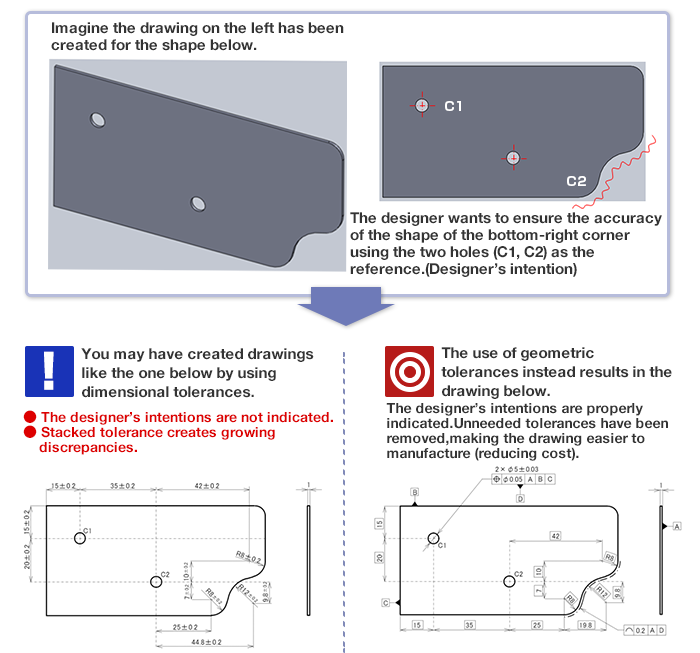
Reducing cost by improving drawings
As you can see from the example given in "Tolerance design and geometric tolerances" above, poor drawings result in greater cost.
Reviewing and improving your current drawings will let you eliminate reworking and reduce cost. Look for problems such as:
- Unneeded tolerances
- Ambiguous areas in shape definitions
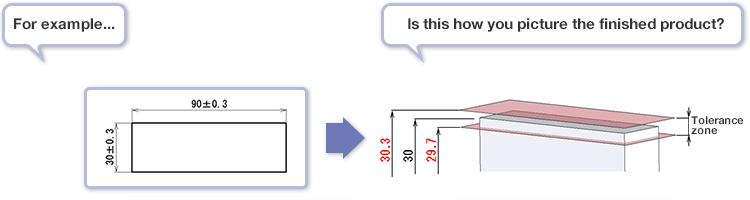
How does this drawing make you picture the finished product? Are you picturing the finished surface shifted in parallel?
But actually, the drawing above could also be specifying the shapes shown below.

Inadequate design drawings lead to problems (cost increases) right away.
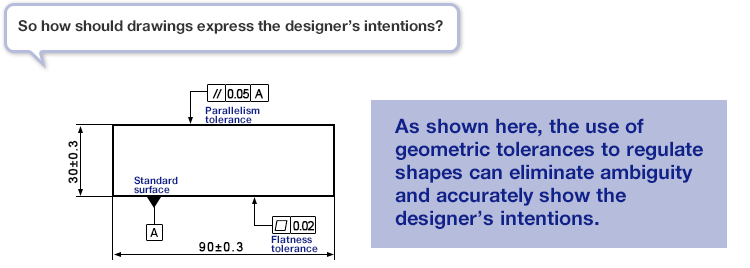
To eliminate the need for reworking resulting from the sort of problems illustrated above, drawings must accurately express the designer's intentions.
PDF list
Payment Method
- Credit Card
- PayPal
- Bank Transfer



Social Media
MISUMI Contact
Copyright © MISUMI Corporation All Rights Reserved.